Phil 4: 4-8

Sunday, December 6, 2015

Keep the Faith

In these days we see continuing evidence of the existence and growth of evil in our culture, in the media, in crime and now apparently in terrorism within this great country’s borders.  We desperately need to stay grounded in our faith, something we can be encouraged in by the examples of those who have gone before us.  Consider the Siege of Jasna Gora in 1655 when the Swedes were threatening to totally overtake Poland.  Anthony Esolen, in a piece for Magnificat, tells us the dramatic story of the battle that turned everything around, thanks to Our Lady of CzÄ™stochowa:

It is a bitter December, 1655.  Twelve thousand Swedes have encamped before Jasna Gora,  [Polish for “Bright Hill”], which is both monastery and fortress.  They have all the vanity and power lust of the never-defeated.  They look upon Jasna Gora as the last fortress to fall [in their invasion and over running of Poland and suppression of the Catholic faith].  If it falls, every Pole will know the war is over.  Jan Casimir [the Polish king] will abdicate, for the sake of his people and that will be that.  The Swedes have cannons, too.  Inside the monastery are 300 men, most of them monks inexperienced in war.

An emissary from the Swedes approaches the monastery…he says, “Every city from here to the Baltic Sea has surrendered.  You are 300.  What can you do...give in.”  The Swedes add a threat.  If the monks do not surrender, they will put the village nearby to the torch.  It will not be the last emissary or the last offer and threat…Some of the defenders have died, the walls are being shelled very day.  Food is running low.  Ammunition is low…Why hold out?

The Poles continue to fight…They also continue to pray, and the Swedes from their tents in the snow will often hear to their surprise and dismay, the sounds of joyous celebration, especially on the feasts of Our Lady and on Christmas Eve…the monastery is the scene of many inexplicable occurrences.  One of the Swedish soldiers blasphemes against Mary and is struck down by a cannonball from the monastery, but the cannon was not aimed at him.  The fatal shot ricocheted from the snow.  Dense fog descends upon the monastery just when the Swedes are advancing to the walls, and then suddenly dissipates, in apparent answer to [the monks’] prayers, leaving the Swedes unprepared and exposed to attack from above.  Swedish cannonballs often rebound from the walls to their own, and that is how their chief cannon is destroyed.

In that same fog, it seems sometimes that Jasna Gora is bathed in a strange light and poised high in the air, so that Swedish shots fall short; sometimes it appears low and close, and the shots sail harmlessly over the monastery…What is most fascinating is the testimony of many of the Swedish soldiers recorded after the siege.  They saw a woman dressed in blue up on the ramparts, pointing the Polish cannons and bringing ammunition.  Some of the Swedes would then drop their weapons in fear.  Sometimes they saw a maiden in white, pointing a sword their way.  One time one of the attackers aimed a cannon at the maiden and its breech exploded, driving the iron back into his face.  Her bearing struck terror into their hearts.  “Who is that witch,” they would say, “who walks upon your walls?”

…Always we will have the world against us. The lesson of Bright Hill is to keep the faith even when all around us have surrendered.  When we meet that woman in blue, let us be able to say, “Lady, be gracious to me!  I’m a sinner and a fool, but I never laid down my sword for comfort or the approval of the world.”

Indeed, it seems we always will have the world against us.  Just read the headlines of the news on any day in this age of secular relativism and political correctness, where what was right is now wrong and vice-versa, where acts of terrorism are called workplace violence, and where God has been pushed out of the public square and religious liberty is on the ropes.

Now, more than ever, we need to heed the words of Our Lady of Fatima, (repeated with increasing urgency and emphasis in the 20th century at Kibeho and Akita:
“As I told you, if men do not repent and better themselves, the Father will inflict a terrible punishment on all humanity. It will be a punishment greater than the deluge, such as one will never have seen before. Fire will fall from the sky and will wipe out a great part of humanity, the good as well as the bad, sparing neither priests nor faithful. The survivors will find themselves so desolate that they will envy the dead.

The only arms which will remain for you will be the Rosary and the Sign left by my Son. Each day, recite the prayers of the Rosary. With the Rosary, pray for the Pope, the bishops and the priests. The work of the devil will infiltrate even into the Church in such a way that one will see cardinals opposing cardinals, and bishops against other bishops. The priests who venerate me will be scorned and opposed by their Confreres. The Church and altars will be vandalized. The Church will be full of those who accept compromises and the demon will press many priests and consecrated souls to leave the service of the Lord.

So how about it?  Are we praying our Rosary daily?  Are we calling upon Our Lady for her intercession in these difficult times, and for the grace we need to be prepared for what lies ahead?  No time like now to start if one hasn’t been doing this.

And a special word to the guys who read this: as author David Calvillo says, “Real Men Pray the Rosary.”  His book with that title provides some background on the Rosary and spiritual food for thought for men who might be interested.  BUT—you don’t need a book—just start or begin again to pray the Rosary, ASAP.  The Rosary is not just a devotion for kids and women, guys.  It is a Christ-centered prayer available to, and commended to, us ALL. 

Our Lady helped the faithful at Jasna Gora.  She’ll help us as well if we only do what she asks of us.  Can we do it?  Can we encourage others to do so by our example?  Will we do it? 

At some time in the not too distant future, many believe, we’ll wish we had taken Our Lady's exhortations more seriously.  There’s still time.  Start now.


Saturday, November 28, 2015

More Thoughts on Adoration of the Most Holy Sacrament


The Eucharist—A Priceless Treasure
To continue our discussion on Eucharistic Adoration, let’s consider what Pope St. John Paul II had to say about it in his encyclical, Ecclesia de Eucharistia:

“It is pleasant to spend time with him, to lie close to his breast like the Beloved Disciple (cf. Jn 13:25) and to feel the infinite love present in his heart. If in our time Christians must be distinguished above all by the “art of prayer”, how can we not feel a renewed need to spend time in spiritual converse, in silent adoration, in heartfelt love before Christ present in the Most Holy Sacrament? How often, dear brother and sisters, have I experienced this, and drawn from it strength, consolation and support!

This practice, repeatedly praised and recommended by the Magisterium, is supported by the example of many saints. Particularly outstanding in this regard was Saint Alphonsus Liguori, who wrote: “Of all devotions, that of adoring Jesus in the Blessed Sacrament is the greatest after the sacraments, the one dearest to God and the one most helpful to us”. The Eucharist is a priceless treasure: by not only celebrating it but also by praying before it outside of Mass we are enabled to make contact with the very wellspring of grace.”

Perpetual Adoration
During the parish mission conducted recently at St. Francis of Assisi in Castle Rock, signup sheets were available for people to volunteer to spend time in front of the Blessed Sacrament—face time with Jesus.  This is part of the ongoing efforts to generate a practice of “perpetual adoration.”  The goal of perpetual adoration is to have one or more people committed to one of the 168 hours a week to sit in the Real Presence and pray to Jesus.  To some that may sound like a hard commitment to make, but to reiterate a point from the last post on this topic, it’s only one hour a week.  Giving God an hour of our time seems like a pretty uneven swap when we think about what He’s done for each of us and His particular love for each and every one of us.

Lectio Divina
Starting with the first week of Advent for the 2015-2016 liturgical year, the USCCB has a downloadable guide for lectio divina (Latin for “divine reading”) prayer each week.  This is a great starting point for anyone who might want to expand their approach to prayer while in Eucharistic Adoration (or at any other time as well).  In his book, Praying Constantly: Bringing Your Faith to Life, the late Fr. Benedict Groeschel, C.F,R., provides a nice summary of lectio divina at pp. 94 - 97:

  • Calm ourselves—become silent and receptive to whatever God has to say
  • Begin to read a passage slowly—as slowly as possible, dwelling on words and phrases—NOT analyzing or interpreting, but remaining open to let God speak to us.  We don’t need to read too much
  • Pause when something speaks to us in a special way—stop to ponder it—this is the meditation part of divine reading
  • Repeat this over and over for the passage through which God seems to be speaking clearly to us
  • Slowly we move from reading—to meditation—and to prayer
  • In the  prayer part, we let God take the lead and we listen to Him, letting Him guide us in a gentle dialogue
  • Contemplation is the final stage, which involves letting go of words and thoughts, and comes from the grace of God, not from our efforts and happens according to His schedule, not ours.

Father Benedict closes by telling us, “The point of lectio divina is simple.  It is merely to be with God in a stillness interrupted by nothing more than the holy words of Scripture.  It is to let God remove the barriers between Himself and us, one by one, until we are as open as we possibly can be to the movement of God’s Holy Spirit…the rewards can be enormous.

For more information on how to use lectio divina, take a look at Dan Burke’s post at Catholic Spiritual Direction. 

There Are Other Ways as Well
If we don’t feel like doing divine reading, we can just go to visit Jesus and talk with Him.  We can let Him know what’s on our mind, and share with Him what we’re grateful for.  We can let Him know what’s troubling us and let Him help us: 

Jesus said to the crowds: “Come to me, all you who labor and are burdened, and I will give you rest. Take my yoke upon you and learn from me, for I am meek and humble of heart; and you will find rest for yourselves. For my yoke is easy, and my burden light.” – Mt. 11: 28-30

At the end of the day, it’s not so much how we pray but that we actually visit Jesus in the Blessed Sacrament routinely.  He’s waiting, and He wants desperately to see each one of us there.  Let us not disappoint Him.


http://www.vatican.va/holy_father/special_features/encyclicals/documents/hf_jp-ii_enc_20030417_ecclesia_eucharistia_en.html 

http://usccb.us8.list-manage2.com/track/click?u=b927174dbe854683d4b527f98&id=3b6566ebff&e=b6cb03a4e7 

http://www.spiritualdirection.com/2012/04/21/what-is-lectio-divina-and-will-it-help-my-prayer-life-a-guide-to-lectio-divina

Saturday, November 21, 2015

Do You Want to Change Your Life?

To expropriate (and edit) a line from an old Clint Eastwood “Dirty Harry” movie, “Do you want to change your life? Well do you?” 

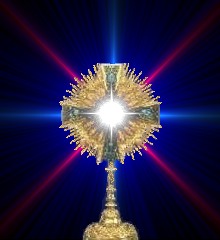
We probably all have an area or two in our lives that we’d like to transform, if only a little, but perhaps a lot.  The good news is that we can, in fact, make those transformations in our lives simply by changing the way we spend just one, or a portion of one, of the 168 hours a week we’re all given in this worldly life.  All it involves is getting face to face with Our Lord in Eucharistic Adoration. 

This last week at St. Francis Assisi in Castle Rock, we were blessed to have Fr. Lou Guardiola, C.P.M. conduct a parish mission on Eucharistic Adoration.  Through a series of presentations over five days, he provided us a great deal of spiritual food for thought on the Holy Eucharist and Eucharistic Adoration.  Due to weather and other factors, many weren’t able to make it to all or some of the presentations.  Others may have some unasked and therefore unanswered questions about Eucharistic Adoration.  

What Is Eucharistic Adoration?
Simply put, it is spending time with Jesus—the Real Presence of Jesus—His body, blood soul and divinity.  Augustine Di Noia, O.P. says, “During Eucharistic adoration, it is not only we who behold Christ, but it is also He who beholds us. When we adore the Blessed Sacrament, we are not just gazing at a beautiful but inert object.”(1)  Yes, God is everywhere and yes, we can talk to Him from anywhere, but He is PHYSICALLY present in the Blessed Sacrament.  And as Father Lou reminds us, it was in His physical presence that Christ performed many miracles; it is in His physical presence in the Eucharist that He will perform many more for us if we ask Him.  Furthermore, spending quality face time with our family or friends is something that we routinely do, or should be doing.  Why wouldn’t we want to spend some quality face time with Our Lord and Savior, (and Friend) as well?

How Does One “Do” Eucharistic Adoration?
In short—we need to just show up—go to the Blessed Sacrament and spend time with Our Lord.  BishopZubik, from Pittsburgh, tells us, “There are many ways to pray. We may meditate silently by gazing on the sacred host.  We may silently speak to Jesus from our mind and heart.  We may also rely on devotions and prayers from Catholic tradition, such as the reading of Scripture, recitation of the Rosary, or the litanies.” (2)  In other words, there’s no one “right” way to adore Jesus in His Real Presence.  We each need to do what works for us. 

When we spend face time with family and friends, we talk and we listen.  That’s a good idea for when we spend face time with Jesus as well—we want to be sure we sit quietly and listen, and avoid what one writer calls the “gimme” approach to prayer.  Now, we shouldn’t make a fuss if we don’t hear a booming voice calling our name when we’re listening for God to talk to us.  Remember what the Bible tells us in 1 Kings: “…and after the earthquake a fire, but the LORD was not in the fire; and after the fire a still small voice…” (emphasis added) (3)  The key is to spend some quality face time with Our Lord and to set aside some of it to just listen and see what He puts on our hearts.  Even if we don’t feel or hear God talking with us at the time, we need to know that He is there with us, loving us with His particular love for each of us and hearing what’s in our hearts.

How Much Time Should I Spend In Eucharistic Adoration?
The bottom line: as much as we can squeeze out for Our Lord who came down to earth to live as a human being and die a horrible death to save us.  He suffered unimaginable agony for each one of us because of each one of us.  Can we honestly say we just don’t have time to sit with Him once in a while?  Is what He did for us less important than the weekly football game or the time we spend in our favorite pastimes?  Is He less important than the mind-numbing television shows and network news reports, or less important than the “friends” we have on Facebook or other social media?

More specifically, what did Our Lord ask Peter at Gethsemane?  “So, could you not watch with me one hour?” (4)  So, is that a hint for us?  Can we spend one hour a week with Our Lord?  That would be ideal—at least one hour a week.  But if we can only get away for twenty minutes or a half hour, we ought to do it.   

As the author at Catholic Bible 101 so eloquently tells us, “Adoration of the Blessed Sacrament is one of the best ways to spend time with Jesus. There is so much noise around us these days.  Spending a quiet hour with Jesus in humble adoration will bring many graces and blessings to you.  Things that you have never even considered before will now be made present to you.  Bad things that would have happened to you will now not happen.”(5) 

And that, my friends, is an understatement!

(3)  1 Kings 19:12
(4)  Mt 26:40

Thursday, September 17, 2015

Getting Right with Our Creator


In a few days, Pope Francis will be visiting Philadelphia.  Nearly forty years ago, Pope St. John Paul II told us during his visit to Philadelphia, “We are now standing in the face of the greatest historical confrontation humanity has ever experienced.  I do not think the wide circle of the American Society, or the wide circle of the Christian Community realize this fully.  We are now facing the final confrontation between the Church and the anti-church, between the Gospel and the anti-gospel, between Christ and the antichrist.  This confrontation lies within the plans of Divine Providence.  It is, therefore, in God’s Plan, and it must be a trial which the Church must take up, and face courageously…We must prepare ourselves to suffer great trials before long, such as will demand of us a disposition to give up even life, and a total dedication to Christ and for Christ.  With your and my prayers, it is possible to mitigate the coming tribulation, but it is no longer possible to avert it, because only thus can the Church be effectually renewed.  How many times has the renewal of the Church sprung from the shedding of blood?  This time too, it will not be otherwise.  We must be strong and prepared and trust in Christ and in his Holy Mother and be very, very assiduous in praying the holy rosary.” (1)

In recent months and weeks some of us have heard of or actually read reports from several experts who are predicting a variety of occurrences which could play out as major catastrophes here in the U.S.  These predictions range from further stock market devaluations, to a major recession or depression, to an all-out global economic meltdown.  There also has been some talk of possible natural disasters which could cripple communication, transportation and economic infrastructure.  And there seems to be an increase in reported “locutions” (2) or private revelations where individuals are receiving warnings of an impending period of dark times during which God’s Divine Mercy will be available to all who wish to avail themselves of it.

Whether or not you believe in any of the negative economic, societal or geopolitical forecasts, and whether or not you believe there’s any substance to any or all of the reported locutions, consider for a moment, “What if…
  • What if everything we’ve known and taken for granted about daily life were to be changed nearly overnight?  Is our relationship with our Lord strong enough to see us through it—have we consecrated ourselves to Him, with a total surrender to His will, or are we still bargaining with Him to do it our way?
  • What if key people and things of the here and now, of this world, were to disappear suddenly from one’s life?  How might that impact us, and to reiterate, is our relationship with our Lord strong enough to see us through it?
  • What if we ourselves were to perish before our previously “estimated time of departure”?  Do we still have some reconciling to do with Him before that happens?
  • None of us knows the day or time of our departure from this life, whether it’s facilitated by old age and natural causes or by something unexpected happening.  But—what if—as we say in the succession management business—“What if the beer truck ran over you today?”

Indeed, what can we do to get closer to our Creator, starting right now?  Numerous Catholic authors, including priests, have suggested what we ought to be doing in order to live in the present moment, taking full advantage of God’s grace in our lives.  The following is a synopsis of multiple Catholic authors’ suggestions for creating or strengthening our prayer and spiritual routines.

Daily:
Prayer routine—start and end the day with some brief prayers of adoration, thanksgiving and supplication—it doesn’t have to be more than a few minutes if that’s all the time you have available. The morning offering prayer is a great way to start the day.
Scripture reading and meditation—(A/K/A Lectio Divina) spend a little time each day reading the Word of God, pondering, meditating on it and what it means to you, asking for the Holy Spirit’s guidance for you.
Rosary—Carry a Rosary with you, and pray one full Rosary of five decades a day.
Divine Mercy chaplet—pray one a day—this only takes about seven to ten minutes.
End of day examination of conscience—in the evening, review what your day has been like, where you’ve fallen short and ask for God’s forgiveness and the grace to avoid doing it again.

At Least Weekly:
Mass and reception of Holy Communion—we are SO blessed in the       U. S. Catholic Church to have routine access to the Holy Eucharist!  While we will meet our minimum obligations by attending weekly Mass, if it’s at all possible, we ought to look at more frequent reception of Communion. 
Eucharistic Adoration—an hour a week with our Lord’s physical presence—his body and blood, soul and divinity.  Fr. Lou Guardiola, CPM characterizes it aptly—“In like a lion, out like a lamb.”  Spend some quiet time with Jesus—he’s our friend.  Don’t we try to spend quality time with our friends?

At Least Monthly:
Confession—this is another blessing we have in our Church.  Most spiritual directors and authors recommend taking advantage of this sacrament at least once a month.  But, of course, if we have committed a sin that’s been particularly hurtful to our Lord, we don’t need to wait for the passage of time to attend confession again.  In most communities there are a number of parishes with different times for regularly scheduled confession, but one can make an appointment to see a priest outside of scheduled confessions as well.  To be clear, if we’re in need of reconciliation at any time, we need to get to confession ASAP—remove the stain of sin and open ours souls to God’s grace. 

The State of Grace
Our goal should be to stay in a state of grace, which means avoiding sin, and confessing and repenting it when we don’t avoid it.  Fr. Pierre Garrigou-Lagrange, OP a theological advisor to four popes, tells us that even venial sin is an infinite offense against God, because God is an infinite being; it is an outrage and serious ingratitude toward God.  Sin, even venial sin, deprives us of the precious grace of God.  And once we deprive ourselves of that grace, we can never get the time back during which we wasted the potential access to the grace—never.  Venial sin, according to Garrigou-Lagrange, hinders our exercise and demonstration of charity.  It can lead us to mortal sin through its creation of a spiritually tepid state in us.  Fr. Pierre suggests that we always should take advantage of the opportunity to pray, because even when our souls are in a tepid state, we still have the grace to pray.  So, as St. Paul exhorts us, in 1 Thessalonians 5:17, "Pray without ceasing."

Sounds like good advice to me.  We never know the day or the time…


Notes:
  1.         Magnificat October 22nd, 2013 on the Memorial of Blessed Pope John Paul II, quoting his statement made in Philadelphia, 1976; blog post at Quartermaster of the Barque, http://qmbarque.com/2013/11/13/cardinal-wojtyla-pope-john-paul-ii-and-prophecy-in-1976/
  2.             From Catholic Answers: “A locution is a form of private revelation, similar to an apparition, but rather than being seen a locution is heard or received internally. As with all claims of private revelation it is important to be certain that a locution is authentic before any recognition or significance is determined.” http://www.catholic.com/quickquestions/what-is-a-locution


Saturday, September 12, 2015

Devotion to the Holy Rosary

On numerous occasions, Our Lady has asked us to pray, and more particularly, to pray the Rosary.   You can ask anyone who routinely prays the Rosary and they will tell you how much it means to them, to their prayer life, and to their general consolation and sense of peace in their life.  It is a great gift to us, commended by many saints, including Pope St. John Paul II, who wrote, in in his Apostolic Letter, Rosarium Virginis Mariae:

“The Rosary, though clearly Marian in character, is at heart a Christocentric prayer. In the sobriety of its elements, it has all the depth of the Gospel message in its entirety, of which it can be said to be a compendium. (1)  It is an echo of the prayer of Mary, her perennial Magnificat for the work of the redemptive Incarnation which began in her virginal womb. With the Rosary, the Christian people sits at the school of Mary and is led to contemplate the beauty on the face of Christ and to experience the depths of his love. Through the Rosary the faithful receive abundant grace, as though from the very hands of the Mother of the Redeemer…. she continually brings to birth children for the mystical Body of her Son. She does so through her intercession, imploring upon them the inexhaustible outpouring of the Spirit. Mary is the perfect icon of the motherhood of the Church.

… [it] mystically transports us to Mary's side as she is busy watching over the human growth of Christ in the home of Nazareth. This enables her to train us and to mold us with the same care, until Christ is “fully formed” in us (cf. Gal 4:19). This role of Mary, totally grounded in that of Christ and radically subordinated to it, “in no way obscures or diminishes the unique mediation of Christ, but rather shows its power… (2)

Dear brothers and sisters! A prayer so easy and yet so rich truly deserves to be rediscovered by the Christian community…I look to all of you, brothers and sisters of every state of life, to you, Christian families, to you, the sick and elderly, and to you, young people: confidently take up the Rosary once again. Rediscover the Rosary in the light of Scripture, in harmony with the Liturgy, and in the context of your daily lives…”

The Rosary is what’s known in the Church as a “sacramental,” something that is “…instituted for the sanctification of certain ministries of the Church, certain states of life, a great variety of circumstances in Christian life, and the use of many things helpful to man…  (CCC 1668).  “Sacramentals do not confer the grace of the Holy Spirit in the way that the sacraments do, but by the Church’s prayer, they prepare us to receive grace and dispose us to cooperate with it. For well-disposed members of the faithful, the liturgy of the sacraments and sacramentals sanctifies almost every event of their lives with the divine grace…” [Emphasis added] (CCC 1670)

Rosaries are composed of 59 beads, a crucifix and often, a center piece.  An interesting fact: the word “bead” comes from the old English word “bede,” which meant “prayer.”  In the middle ages, most lay people, including lay members of religious orders usually had neither the education to read, nor access to, the psalters that were used by the religious in monasteries for daily prayers.  Consequently, they ended up using a string of beads, originally called “Pater Nosters,” (Latin for “Our Father”), to count the Hail Marys and Our Fathers as they prayed.  Between the 12th and 15th centuries, the Rosary evolved to the point that 50 Hail Marys were recited with it. (3)  In 1569, under Pope St. Pius V, the Rosary came into the general form with which most of us are familiar, ultimately with three sets (Joyful, Glorious and Sorrowful) of five mysteries each.  Later, in 2002, Pope St. John Paul II added the five Luminous Mysteries.  (Actually, according to the Magnificat Rosary Companion, he restored these mysteries which had existed in an earlier version predating the fifteen mysteries we were familiar with.)

So how about it, brothers and sisters, isn’t it time for all of us to rediscover the Rosary?  Or if we have rediscovered it, to spend more time with it, perhaps?  If anyone you know needs a refresher on praying the Rosary, there are abundant resources available to help.  Most parish gift shops have some sort of pamphlet covering how to pray the Rosary.  Some online resources include the following, which are rated highly for fidelity to Catholic teaching by the Catholic Culture website (click on the name to be taken there):


And what if you or someone you know needs a Rosary?  Rosaries are available in prices ranging from less than a dollar apiece to a few hundred or more, depending on what they’re made of.  You can find them at parish gift shops, Catholic religious supply stores and online.  No matter where you get them, make sure you get them blessed.  Following are links to some online Rosary purveyors:


Tradition holds that Our Lady made fifteen promises to those who pray the Rosary.  You can find the 15 Promises of The Blessed Virgin for Praying the Rosary online.  For a great summary on the Rosary and how to pray it, as well as information on the Confraternity of the Most Holy Rosary, click here.

Enjoy your special time with Our Lady and Our Lord Jesus in your praying of the Holy Rosary!

Notes:
1 - Pope Paul VI, Apostolic Exhortation Marialis Cultus (2 February 1974), 42: AAS 66 (1974), 153.
2 - Second Vatican Ecumenical Council, Dogmatic Constitution on the Church Lumen Gentium, 60.
3 -  St. Dominic, founder of the Order of Preachers (Dominicans), had been given credit, erroneously, for devising the Rosary, due in part to the writings of Alan de la Roche, who was not a contemporary of St. Dominic.  However, St. Dominic is reported to have fostered a devotion to it, using it in his missionary work.


Monday, September 7, 2015

True Devotion to Our Lady

In previous posts, we covered a few of the many documented miracles attributed to a devotion to Our Lady and related to sites of her appearances, or apparitions, (and there have been numerous approved instances of Our Lady’ apparitions).  There are many, many more accounts of miracles and apparitions that have not been vetted or officially approved.  These facts alone are strong evidence of the salutary effects of a devotion to Our Lady.  But, as the infomercials say, “Wait!  There’s more!”

St. Louis-Marie Grignon de Montfort really nailed down the whole concept of devotion to Our Lady and to Our Lord Jesus through Our Lady in his classic work, True Devotion to Mary.  This book stayed virtually undiscovered until after his death and the end of the French Revolution.  Since its discovery in 1842, it has been recognized as the greatest book on Our Lady.  It has been recommended and practiced by eight Popes.  In fact, Pope St. John Paul II said that this book,

“…was a decisive turning point in my life.  I say ‘turning point,’ but in fact it was a long inner journey… [it] is indispensable to anyone who means to give himself without reserve to Christ…It is from Montfort that I have taken my motto, ‘Totus Tuus’ (I am all thine).”

Here’s the bottom line according to St. Louis de Montfort:  The greatest thing we can strive for is to be conformed to, and united totally with, Christ.  That being the case, then any devotion that will help us the most to conform ourselves to and unite us with Jesus would be the ideal form of devotion to follow.  That makes sense, right?  Well then, St. Louis says, who was more conformed to and united with Christ in their lifetime than the Blessed Virgin Mary?  From the moment she gave her Fiat at the annunciation, to the time she received Jesus’ body from the cross, Our Lady was totally united with, consecrated to, and an instrument of God’s will. 

Is that powerful, or what?  Think about it—who is a better role model for following God’s will and being united to Him than Our Blessed Mother?  St. Louis de Montfort provides a method of consecrating ourselves to Our Lady and to Our Lord through Our Lady over a period of 33 days.  It’s all laid out in his book.  But don’t let the 33 days of preparation frighten you away from it.  The regimen over the month or so of time simply involves daily prayers and reflections—something we probably already are doing in one form or another anyway. 

In the last few years, another approach to Marian consecration has been developed and explained in his book, 33 Days to Morning Glory, by Fr. Michael Gaitley, MIC.  In his book, Fr. Gaitley draws upon St. Louis de Montfort’s approach to consecration, as well as the lives and Marian devotional practices two other saints, St. Maximillian Kolbe and Pope St. John Paul II, together with those of Blessed Mother Teresa of Calcutta, to formulate his method of consecration.  Fr. Gaitley, whose order, the Marians of the Immaculate Conception have a great love and zeal for Mary Immaculate, believes that this formula of consecration can help anyone jump start or rekindle a strong devotion to Our Lady, and to Jesus through her.  Fr. Gaitley’s approach, written in the current time for Catholics of our day, although spanning 33 days like St. Louis’ uses what some might perceive to be a less demanding daily schedule of prayers and reflections. 

We first read and used Fr. Gaitley’s approach for our consecration to Our Lady.  It was a great experience, and I’d commend it to anyone who wants to ramp up their prayer life and devotion to Our Lord and Our Lady.  Absolutely anyone can take a little time each day to prayerfully work through this method of consecration, and it will yield great spiritual benefits.  In the interest of full disclosure, I will also tell you that I subsequently did a re-consecration using St. Louis de Montfort’s True Devotion to Mary and it was incredibly rewarding as well.  So which one is best for you?  Consider getting a copy of each and scan through them, then pick the one you’d like to use.  You can get a Kindle version of each for about $3 - $7 or used paperbacks from about $5 + $3.99 shipping, so it shouldn’t break the bank if you want to take a look at both of them. 

You can get much deeper into the scriptural basis for all of this by actually reading True Devotion to Mary, and/or 33Days to Morning Glory.   As well, for inquiring minds who want to delve more deeply into the scriptural basis for Mary as Mother of God and related issues, Patrick Madrid’s book, Where Is That in the Bible has an easy-to-read chapter on the topic, and Fr. Mitch Pacwa has written a great little book on the subject, Mary—Virgin,Mother and Queen.   (You can never have too many devotional books, although I am attempting to maintain a personal book-buying moratorium right now, just to prove to myself that I can stop buying books.  J )  

And please keep in mind that Our Lady, Our Blessed Mother, is watching over us and wants to help us.  We should not only pray to Jesus, Our Heavenly Father and the Holy Spirit, but we should also ask Our Blessed Mother for her intercession.  As the Queen Mother, she will perfect our requests and present them to Jesus, advocating our causes for us, (and who can resist a mother’s insistent request, right?) 

Our Blessed Mother loves us and won’t let us down: 

Memorare

Remember, O most gracious Virgin Mary, that never was it known that anyone who fled to thy protection, implored thy help, or sought thine intercession was left unaided.

Inspired by this confidence,     I fly unto thee, O Virgin of virgins, my mother; to thee do I come, before thee I stand, sinful and sorrowful. O Mother of the Word Incarnate, despise not my petitions, but in thy mercy hear and answer me. 

Amen.


To be continued...

Thursday, September 3, 2015

Why Should We Be Devoted to Our Lady and the Rosary?

In my last post, I suggested that we may want to ramp up our prayer life, and in particular, our prayers for the intercession of Our Blessed Mother, through and with the Holy Rosary.  But other than the messages noted from the major apparitions mentioned in that post, what other reasons might we have for a strong pursuit of the Rosary as a routine form of prayer?  Through Our Lady, big things can happen.  Her magnanimity, coupled with our humility, can make an incredible difference in our lives.  Consider the examples below:

St. Juan Diego’s Tilma
Nearly 500 years after Our Lady appeared to St. Juan Diego in 1531, on a knoll near Mexico City, the tilma of St. Juan Diego has been preserved from decay.  The image on the tilma cannot be explained by any scientific means.  This, of course, is on top of the fact that after our Lady’s appearance, over about a ten-year period of time, some 8 to 9 million people in Mexico became Catholic.

Battle of LePanto
In 1571, Pope St. Pius V called on all Catholics to pray the Rosary for the fleet of the Holy League as it entered into battle with the Ottoman navy.  As the battle began, the wind shifted and the badly outnumbered and outgunned Holy League won the battle, preserving Europe from a Muslim conquest.  (This is where the Feast of Our Lady of Victory, later changed to Our Lady of the Rosary originated.)

St. Catherine Laboure
Our Lady appeared to St. Catherine in 1830 and gave to her the image for the Miraculous Medal—a sacramental that is virtually universally known throughout the Catholic faith.  Now, nearly 200 years later, St. Catherine’s body remains incorruptible.  It has not been artificially preserved and yet it shows no decay.

Fr. Ratisbone
While wearing the Miraculous Medal to humor a Catholic friend, a Jewish convert, who later became Fr. Marie-Alphonse Ratisbone, was converted in 1842 after seeing a vision of the Virgin of the Miraculous Medal. After that occurred, he devoted his life to the conversion of the Jews,  even building the Ecce Homo Convent of the Sisters of Zion, located on the Via Dolorosa in Jerusalem.

St. Bernadette Soubirous
Our Lady appeared in 1858 to St. Bernadette, a 14-year old French peasant girl, who by all accounts was a very ordinary person.  Since that time, approximately 7,000 recorded miraculous healings have occurred at Lourdes.  About 70 of these have been verified officially as totally inexplicable by any scientific means, but the recipients of the healing in the rest of those miracles know what occurred for them as well.

Champion, Wisconsin
In 1859 Our Lady appeared to Adele Brise at a site which lies about 30 minutes by car from present day Green Bay, as Our Lady of Good Help.  Numerous healings have occurred at that shrine as well, one of which was for the baby grandchild of a personal acquaintance of ours a few years ago. Additionally, in 1871 the largest and deadliest fire in American history burned 2,400 square miles of woodlands in the area, incinerated a dozen communities, and killed 2,500 people.  Although the surrounding area was burned and the outside of the picket fence around the property was charred, the compound at the chapel of Our Lady of Good Help was saved from the fire after Sister Adele led local citizens in prayer at the church.

Fatima, Portugal
At Fatima Our Lady appeared to three children six times over five months.  In addition to the messages she gave them for the world, a miracle, referred to as that of the dancing sun was witnessed by 60,000 to 70,000 people at the final apparition.

Other Marian Miracles and Apparitions
In addition to the apparitions and miracles recorded with respect to each of the above sites, there are other apparitions that have been noted, some of which have been approved by the bishops in whose dioceses they occurred.  As well, in a recent, informal discussion among a small group of Catholic men, including priests and laity, recorded at a home in Birmingham, one priest, an expert on Middle East religion and culture, noted that in the last few years, numerous Muslims (hundreds of thousands if I recall correctly) have been called to conversion by apparitions or locutions from the Blessed Mother and/or Jesus.

But there are many, many more personal Marian miracles and examples of guidance and graces obtained through Our Lady among the faithful.  Father Larry Richards of The Reason for Our Hope Foundation has mentioned Our Lady’s guidance for him with respect to his vocation, as have other priests we’ve known or known of over the years.  In our own lives, Our Lady has played a major role in our spirituality through her intercessions for us.  She can do the same for each and every one of us—if we ask for her intercession. 

To be continued…